
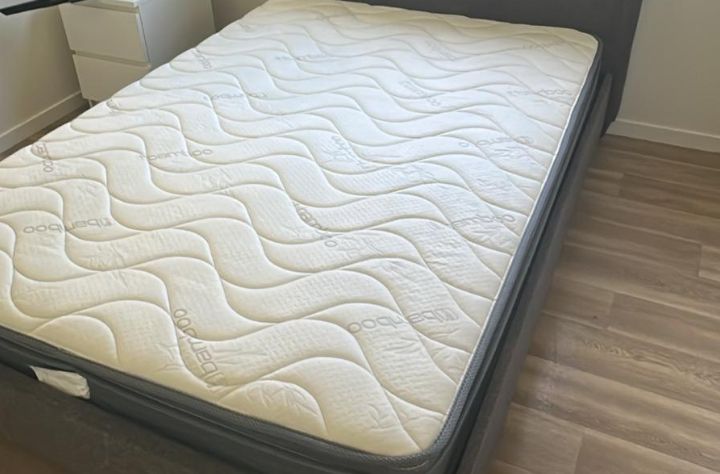
Professional mattress cleaning is the better choice when your mattress is structurally sound, less than 8 years old, and the main problems are stains, odors, or allergens. Replacing the mattress is the better choice when you see visible sagging, feel springs or coils, wake up with pain that goes away after you get up, or the mattress is over 10 years old. The decision comes down to whether the mattress is dirty or whether it is worn out. Cleaning fixes the first. Replacement fixes the second. No amount of cleaning restores a collapsed support core.
This is a decision that catches many homeowners off guard. You strip the bed, notice the stains, maybe smell something stale, and suddenly wonder whether you should call a cleaner or start shopping for a new mattress. Both options cost money. Only one makes sense for your specific situation. Let's walk through exactly how to decide, what each option costs, what each actually accomplishes, and the scenarios where one clearly beats the other.
The Core Distinction: Dirty Versus Worn Out
Everything in this decision flows from one simple question. Is your mattress dirty, or is it worn out?
A dirty mattress has accumulated sweat, dead skin, dust mites, body oils, and stains. The materials inside are still functional. The support layers still support. The comfort layers still cushion. Cleaning restores hygiene and freshness.
A worn-out mattress has lost its structural integrity. The foam has compressed and will not rebound. The springs have lost tension or are broken. The support core no longer holds your spine in alignment. Cleaning does nothing for this. The mattress is mechanically finished.
Think of it like a car. You wash and detail a dirty car. You do not wash and detail a car with a blown engine and expect it to run again. Your mattress works the same way.
Signs You Should Clean, Not Replace
Schedule a professional cleaning if these describe your mattress.
- Visible stains but no sagging. Yellow sweat marks, old urine stains, drink spills. The mattress surface is discolored but flat and supportive.
- Noticeable odor. A musty, sour, or stale smell, especially when you change the sheets. This is biological material decomposing in the fabric and top layers. Cleaning removes it.
- Allergy symptoms that worsen at night. You wake up congested or sneezing, but symptoms improve after you leave the bedroom. Dust mite allergens are the likely culprit. Cleaning reduces the allergen load significantly.
- The mattress is less than 7 years old. Most quality mattresses have a design life of 7 to 10 years. If yours is in the first half of its lifespan and has no structural issues, cleaning is a smart investment.
- You have never had it professionally cleaned. Most people never clean their mattresses. If yours is several years old with zero professional attention, it is overdue regardless of how it looks.
- Someone was recently sick in the bed. After a gastrointestinal illness, a respiratory infection, or any contagious sickness, sanitizing the mattress is a reasonable health measure.
- You are preparing for a new baby or a guest. Cleaning a guest mattress before visitors arrive is both hygienic and hospitable.
Signs You Should Replace, Not Clean
Start shopping for a new mattress if these describe yours.
- Visible sagging or body impressions. If you see a depression where you sleep that does not spring back when you get up, the foam or fiber layers have permanently compressed. Cleaning will not fill that hole.
- You can feel springs or coils through the surface. The comfort layers have worn through. The support system is pressing directly against your body. This is a structural failure.
- You wake up with back, hip, or shoulder pain that resolves after you get up and move around. Your mattress is no longer supporting proper spinal alignment. This is the most reliable indicator of a worn-out mattress because it correlates directly with lost support.
- The mattress is over 10 years old. Even a mattress that looks fine may have degraded internally. The National Sleep Foundation recommends replacement at 7 to 10 years. Foam loses resilience. Springs fatigue. Materials break down.
- The edge collapses when you sit on it. Edge support failure means the perimeter structure is gone. This is not repairable.
- Noisy springs. Squeaking, creaking, or popping when you move indicates metal fatigue in the coil system. Lubrication is not a solution for mattress springs.
- You sleep better on other mattresses. If you consistently wake up feeling better after sleeping on a hotel bed or a guest bed, your mattress is no longer serving you.
Cost Comparison Over Time
The financial comparison is not just about today's cost. It is about value over the remaining life of the mattress.
Scenario 1: Clean a 5-Year-Old Mattress
Your mattress cost $1,200 and has a 10-year expected lifespan. You have 5 years of use remaining. A professional cleaning costs $100 to $150.
Cost per remaining year: $20 to $30 per year.
The cleaning extends the usable life by restoring hygiene without addressing structure, which is not yet a problem. This is excellent value.
Scenario 2: Replace a 5-Year-Old Mattress
Same mattress. You replace it instead of cleaning because of stains and odor. New mattress costs $1,200.
You spent $1,200 to solve a problem that $150 could have solved. You lost $1,050. The new mattress is nice, but you did not need it.
Scenario 3: Clean an 11-Year-Old Mattress
Your mattress cost $1,200 and is past its expected lifespan. It has mild sagging and you wake up stiff occasionally. You spend $150 on professional cleaning.
The mattress smells fresh. It still sags. You still wake up stiff. You spent $150 on a mattress you should have replaced. That $150 should have gone toward a new mattress.
Scenario 4: Replace an 11-Year-Old Mattress
Same situation. You replace the mattress for $1,200. Your back pain resolves. You sleep better. The cost was necessary and appropriate.
Summary Table
| Action | Mattress Age | Mattress Condition | Cost | Smart Choice? |
|---|---|---|---|---|
| Clean | 3-7 years | Stained, odorous, structurally sound | $100-$150 | Yes |
| Clean | 8-10 years | Structurally sound, no pain on waking | $100-$150 | Reasonable if you want 1-2 more years |
| Clean | 8-10 years | Sagging, pain on waking | $100-$150 | No, waste of money |
| Clean | 10+ years | Any condition | $100-$150 | No, replace |
| Replace | 3-7 years | Structurally failed, sagging, pain | $1,000-$3,000 | Yes, warranty may apply |
| Replace | 8-10 years | Sagging, pain, noisy springs | $1,000-$3,000 | Yes |
| Replace | 10+ years | Any condition | $1,000-$3,000 | Yes |
What Professional Cleaning Actually Does and Does Not Do
You need realistic expectations about what cleaning accomplishes.
What Cleaning Does
- Extracts accumulated sweat, body oils, and skin cells from the upper layers of the mattress
- Reduces dust mite populations and their allergenic droppings
- Removes or significantly reduces surface stains from sweat, urine, vomit, and spills
- Eliminates odors caused by biological decomposition
- Sanitizes the surface with antimicrobial agents or UV light
- Freshens the mattress so it smells clean
What Cleaning Does Not Do
- Restore compressed or collapsed foam layers
- Repair broken or fatigued springs
- Fill in body impressions or sagging areas
- Fix torn fabric or damaged edges
- Extend the structural lifespan of the support core
- Turn a low-quality mattress into a high-quality mattress
- Improve spinal alignment or pressure relief
Cleaning is hygiene. It is not structural repair. Conflating the two leads to disappointment and wasted money.
The Mattress Protector Factor
Whether you have used a mattress protector heavily influences the clean-versus-replace decision.
A quality waterproof, breathable mattress protector blocks moisture, skin cells, and dust mites from entering the mattress. If you have used one consistently since the mattress was new, the interior of your mattress is significantly cleaner than an unprotected mattress of the same age.
For a mattress that has always been protected, professional cleaning may be needed less frequently. The surface may still need stain treatment if spills soaked through the protector, and dust mites can still live on the surface fabric, but the deep interior has been shielded. This tilts the decision further toward cleaning and further from replacement.
If you have never used a protector and your mattress is several years old, the interior has absorbed everything your body releases each night. Cleaning can help but cannot reverse years of deep saturation. This tilts the decision toward earlier replacement, especially if the mattress is approaching the 8-year mark.
Situations Where Both Cleaning and Replacement Are Wrong
Some situations call for neither cleaning nor replacement. Understanding these exceptions prevents wasteful spending.
Manufacturer Warranty Applies
If your mattress is less than 10 years old and has visible sagging greater than 1 to 1.5 inches, which is the typical warranty threshold for most manufacturers, with no visible stain damage that voids the warranty, you may be eligible for a warranty replacement. Do not clean or replace. File a warranty claim first.
Mattress warranties typically cover manufacturing defects and excessive sagging. They do not cover stains, odors, or normal softening. Check your warranty documentation. Take photos of the sagging with a straight edge and a ruler. Contact the retailer or manufacturer.
Mattress Can Be Repaired
In rare cases, a mattress can be repaired. If the cover is torn but the interior is intact, the cover can sometimes be replaced or patched. If a single foam layer has failed in a layered mattress, some manufacturers sell replacement layers. This is more common with higher-end mattresses and online bed-in-a-box brands that use zippered covers. Repair is not possible for most traditional innerspring mattresses.
You Are Moving Soon
If you plan to move within 6 to 12 months, do not invest in either professional cleaning or a new mattress right now. Wait until you are in the new home. Moving a mattress adds wear and risk of damage. Clean or replace after the move.
What Happens If You Choose Wrong
You Clean a Mattress That Should Be Replaced
You spend $100 to $150. The mattress smells better and looks better for a short time. The structural problems remain. You continue to sleep poorly. Within a few months, the stains and odors begin to return because the worn-out materials absorb and retain moisture more readily. You eventually replace the mattress anyway. The cleaning cost is sunk.
You Replace a Mattress That Only Needed Cleaning
You spend $1,000 to $3,000. You get a nice new mattress. It is a fine outcome in the sense that you now have a clean, supportive bed. But you spent far more than necessary. If the old mattress had 3 to 5 years of life left, you effectively paid for those years twice. The old mattress goes to a landfill unnecessarily.
You Do Nothing
You continue sleeping on a dirty, worn-out mattress. Your allergy symptoms persist or worsen. Your sleep quality degrades gradually, which makes it harder to notice the decline. You may develop or worsen back pain. The mattress becomes increasingly unhygienic. This is the worst outcome because it affects your health, not just your wallet.
How to Decide in 5 Minutes
Use this quick decision framework.
- How old is your mattress? If over 10 years, replace. If under 8 years, continue.
- Do you see sagging or feel springs? If yes, replace. If no, continue.
- Do you wake up with pain that goes away after getting up? If yes, replace. If no, continue.
- Are there stains, odors, or allergy symptoms at night? If yes, clean. If no to all of these, your mattress may not need anything right now.
This framework works for the vast majority of situations. The edge cases, like an 8-year-old mattress with mild odor and no structural issues, require judgment. In those gray areas, a professional cleaning at $100 to $150 is a reasonable gamble. If it solves the problem, you bought several more years of use. If it does not, you lost a small amount and can proceed to replacement with confidence.
The Hidden Cost of Sleeping on a Worn-Out Mattress
The cost of a bad mattress goes beyond the mattress itself.
Poor sleep quality is linked to reduced cognitive performance, impaired immune function, increased stress hormone levels, and higher risk of chronic conditions including obesity, diabetes, and cardiovascular disease. These are well-documented in medical literature, including research from the Centers for Disease Control and Prevention and the National Institutes of Health.
If your mattress is causing you to sleep poorly, the financial cost of replacement is trivial compared to the health costs of chronic sleep deprivation. A $1,500 mattress that lasts 10 years costs $150 per year. That is $0.41 per night. You cannot buy better sleep for less than that.
This does not mean you should replace your mattress every time you have a bad night. But if you consistently wake up tired and achy, and you have ruled out other causes, your mattress is a likely contributor. Do not economize on the surface you spend a third of your life on.
Frequently Asked Questions
Can I just rent a steam cleaner and clean the mattress myself?
Home carpet and upholstery machines can help with surface cleaning but lack the vacuum power and water temperature of professional equipment. The bigger risk is leaving too much moisture in the mattress. A damp mattress grows mold. If you DIY, do it on a hot, dry day, use fans, and wait until the mattress is completely dry before putting sheets back on.
How much does professional mattress cleaning cost?
Standard professional mattress cleaning costs $75 to $150 for a mattress up to queen size. King and California king mattresses run $100 to $200. Deep stain treatment, sanitization, or allergen treatment may cost extra. Prices vary by region.
How long does a mattress last with proper care?
The National Sleep Foundation recommends replacement every 7 to 10 years. Higher-quality mattresses, latex and high-density memory foam, can last 10 to 15 years with proper care including a mattress protector and regular cleaning. Low-quality mattresses, low-density polyfoam, may show significant wear at 5 to 7 years.
Does cleaning remove dust mites permanently?
No. Cleaning reduces dust mite populations and removes their allergenic waste products, but dust mites reproduce quickly. The goal is population control, not eradication. Regular cleaning combined with a dust-mite-proof mattress protector keeps allergen levels low.
What about UV mattress cleaning services?
UV-C light at sufficient intensity and exposure time can kill surface bacteria and dust mites. However, UV light does not remove the dead dust mites, their droppings, or the accumulated skin cells and oils. It sanitizes but does not clean. UV treatment is best used as part of a comprehensive cleaning that includes extraction, not as a standalone service.
Should I clean or replace a mattress after bed bugs?
After successful bed bug treatment, professional heat or chemical, have the mattress professionally cleaned to remove treatment residues, dead bugs, and droppings. If the mattress was heavily infested and the fabric is stained or damaged, replacement may be preferable. Consult your pest control professional for a recommendation specific to your situation.
Can a mattress topper postpone replacement?
A mattress topper adds a comfort layer on top of a worn mattress. It can improve pressure relief temporarily but does not fix a failed support core. If your mattress sags in the middle, a topper conforms to the sag. It does not fill it in. A topper can extend the life of a mattress by 1 to 2 years if the support core is still functional but the comfort layers have softened. It cannot save a mattress with broken springs or deep body impressions.
Key Takeaways
Professional mattress cleaning and mattress replacement solve different problems. Cleaning restores hygiene. Replacement restores structure. Confusing the two costs you money.
If your mattress is less than 8 years old, lies flat, supports you without pain, and has stains or odors, clean it. The $100 to $150 investment buys you years of additional use and a fresh sleep environment.
If your mattress sags, has visible body impressions, makes noise, or causes you to wake up in pain, replace it. No cleaning service in the world can rebuild a collapsed support core.
Use a mattress protector from day one of your next mattress. It is the cheapest insurance against the stains and deep soiling that force premature replacement. A $30 protector can add years to a $1,500 mattress.
When in doubt, the age plus sag test is your clearest guide. Over 10 years old? Replace. Visible sagging? Replace. Under 8 years old, flat, and supportive but dirty? Clean. The math is straightforward, and the consequences of guessing wrong are either wasted money or continued poor sleep. You now know enough to decide correctly.